

Ask a business owner in Saudi Arabia who their customer is, and the answer is often “everyone”. Everyone in Riyadh, everyone who needs a lawyer, everyone who owns a car. The trouble is that you can’t write an ad, choose a keyword or build a page for everyone. Finding your target audience means narrowing that answer down to people you can describe, reach and speak to directly.
The short answer: To find your target audience, start with the customers you already have. Write down what each one bought, where they are, what problem made them contact you, who made the decision and how they found you. Look for the patterns. Then check those patterns against real data from Search Console, your Google Business Profile and your ad reports, and write the result as a one-page profile you use for every ad, page and post.
What is a target audience?
A target audience is the specific group of people most likely to need what you sell and pay for it. It is described in enough detail that you can decide where to advertise and what to say. “Women in Saudi Arabia” is not a target audience. “Mothers in north Jeddah who want a children’s dentist that opens after school hours” is.
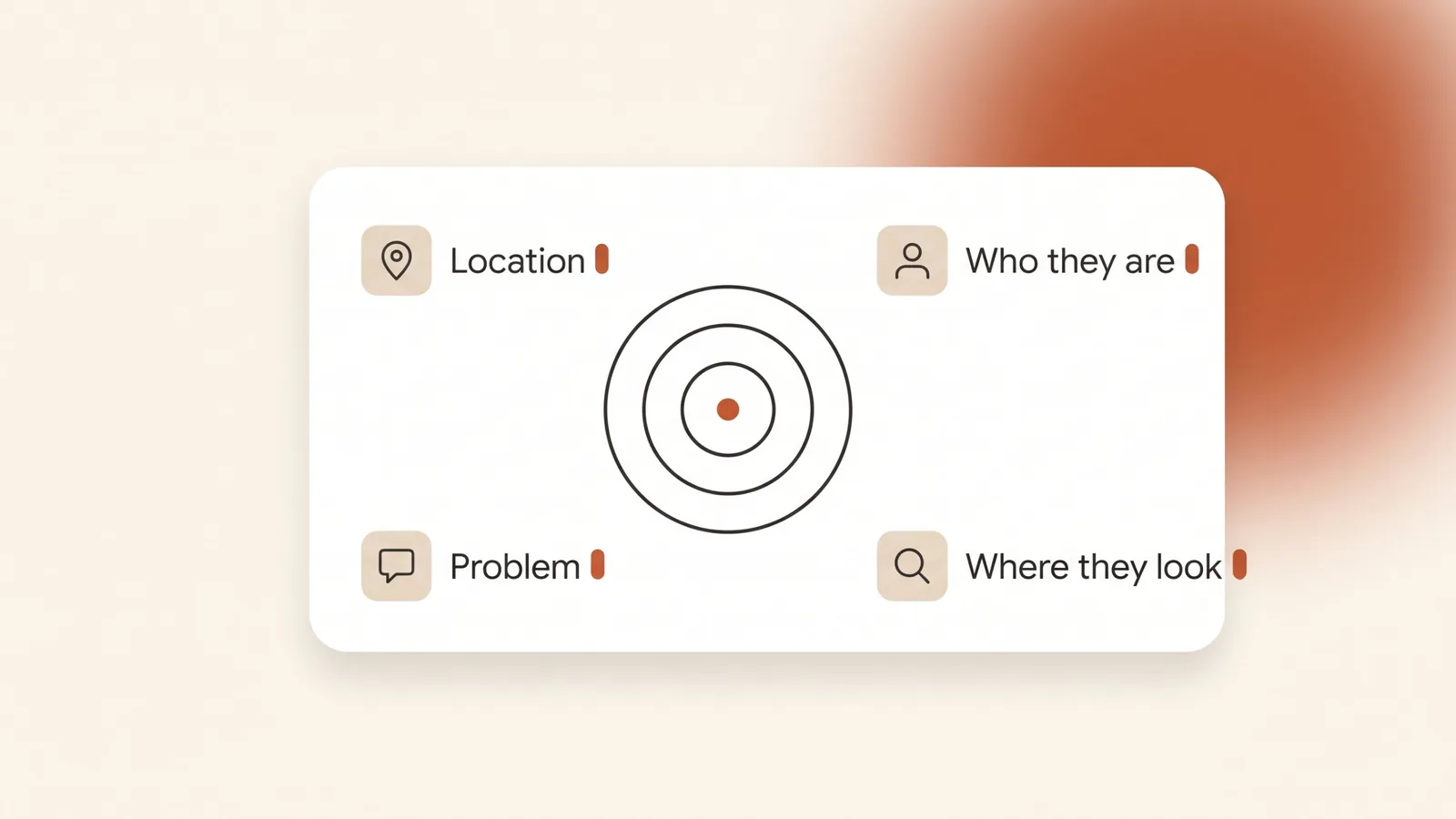
A good description covers four things: who they are, what problem they have, where they are, and where they look for a solution. Age and gender can help, but on their own they rarely tell you what to write. The problem and the place usually tell you more.
Why does it come before ads, SEO or a website?
Every marketing decision depends on it. Your keywords depend on the words your customers use. Your ad locations depend on where they live or work. Your website language depends on whether they search in Arabic, English or both. Your headline depends on the problem they want solved.
If the audience is unclear, each of those decisions becomes a guess. The result is familiar: ads that get clicks but no calls, a website that describes the business instead of the customer’s problem, and social media posts that speak to nobody in particular. Defining the audience first is the cheapest fix, because it costs time, not money.
Step 1: Start with the customers you already have
Your existing customers are the best evidence you have. Take your last 20 to 30 paying customers and write one row for each in a simple sheet. Use these columns:
| Column | The question it answers | Example for a dental clinic |
|---|---|---|
| What they bought | Which service brings the most customers? | Teeth whitening, braces, children’s check-ups |
| Where they are | Which districts or cities do they come from? | Mostly within a short drive of the clinic |
| The problem | What made them contact you now? | A wedding coming up, a child with tooth pain |
| Who decided | Who chose you and who paid? | A parent booking for a child |
| How they found you | Which channel brought them? | Google Maps, a friend, Instagram |
| Language | Did they contact you in Arabic or English? | Arabic on WhatsApp, English by email |
The example column is illustrative, not data from a real clinic.
Once the rows are filled in, look for patterns. You may find that one service brings most of your income, that most customers come from three districts, or that a friend’s recommendation brings better customers than any ad. Pay most attention to the customers you would like more of: the ones who paid well, came back and were easy to work with.
If your business is new, use the enquiries you have received, including the ones that did not buy. You can also read the reviews on competitors’ Google Business Profiles. Reviews show what customers in your city care about, in their own words.
Step 2: Describe the problem, not just the person
People don’t search for a business. They search for a solution to a problem, usually at a specific moment. That moment is the trigger. An air conditioning company in Jeddah gets calls when the summer heat starts or when the unit begins to smell. A labour lawyer gets calls after an employee receives a termination letter. A car service centre gets calls before a long road trip or after a warning light comes on.
Write down the problem in the customer’s words, the trigger that makes it urgent, and what they are afraid of. Someone looking for a lawyer is often afraid of losing money or making the situation worse. Those words belong in your ads and on your page, because they match what the customer is already thinking.
Step 3: Separate who uses it from who decides
The person who uses a service is not always the person who chooses it. In a company, an office manager may search for a supplier while the owner approves the payment. In a family, one son or daughter often books the clinic appointment for a parent. A real estate enquiry may come from one family member and be decided by several.
This changes what you write. The person searching needs clear details: services, location, opening hours and how to book. The person deciding needs reasons to trust you: experience, reviews and a clear way to ask questions. A good page answers both.
Step 4: Draw the map of where they are
For most local businesses, location is the most useful filter. Mark where your customers actually come from, and how far they are willing to travel. A clinic in Jeddah may draw patients from a few nearby districts. A home services company may cover the whole city. A law firm may serve clients across the Kingdom.
This map feeds straight into your ad settings. Google Ads gives two main location options. The default and recommended option, “Presence or interest”, can reach people who are in your area, regularly there, or who have shown interest in it, according to Google’s guide to advanced location options. The “Presence” option reaches only people who are likely to be located, or regularly located, in your area. A business that serves only people in its own city often chooses Presence, so it doesn’t pay for clicks from people who searched about the city from somewhere else.
Step 5: Choose the language they search in
Saudi Arabia has a large non-Saudi population. The General Authority for Statistics estimated the population at 35.3 million in mid-2024, with Saudis making up 55.6% and non-Saudis 44.4%, in its Population Estimates publication for 2024. Depending on your sector, your customers may search in Arabic, in English or in both.
Don’t assume. Look at the language your current customers use on WhatsApp and email, and at the searches that bring people to your site. If both languages appear, you need pages and ads in both. Arabic searches also come in more than one spelling and dialect, which our guide to Arabic SEO for Saudi websites covers in detail.
Step 6: Find out where they look
Your audience looks for solutions in a few places, and they are not the same for every business. Someone with an urgent problem usually searches on Google or Google Maps. Someone choosing a restaurant or a salon may browse Instagram, TikTok or Snapchat first. Someone choosing a lawyer or an accountant often asks a friend, then checks the firm on Google before calling.
The easiest way to find out is to ask. Ask every new enquiry how they heard about you, and record the answer in the same sheet as Step 1. After a month or two, you will know which channels bring customers and which only bring attention. If Google Maps turns out to matter, our guide on how to rank on Google Maps in Saudi Arabia is the next step.
Step 7: Check your guesses against real data
Everything so far is your own view. Free tools from Google show what people actually do, so use them to confirm or correct it:
- Search Console. Its Performance report shows the queries people used to find your site. Google defines queries as the search terms that led to your site, and the same report groups data by country and by device. If you haven’t set it up, follow our Google Search Console setup guide.
- Google Business Profile. The performance report lists the search terms people used to find your business, along with calls, website clicks, direction requests and messages. Direction requests are a good sign of where local customers come from.
- Google Ads, if you already run ads. The location report has a matched locations view that shows where your ads actually appeared. Google notes that these can be users’ physical locations or locations of interest, so read it together with your location setting.
When the data disagrees with your guess, trust the data, then find out why. You may believe customers search for your brand name and discover they search for the problem instead. That is useful: it tells you which pages and keywords to build next.
Write a one-page audience profile
Put everything on one page that you, your team and anyone who markets for you can read in two minutes. Keep it short enough that people actually use it:
- Who they are. One sentence, for example “parents in north Jeddah with children under 12”.
- The problem. In their words, not yours.
- The trigger. The moment that makes them look for a solution now.
- Where they are. Districts or cities, and how far they will travel.
- Language. Arabic, English or both.
- Where they look. Google search, Maps, a specific social platform, friends.
- Who decides. If it is not the same person who searches.
- What stops them. Price worries, trust, distance, waiting times.
Write one profile for each main service if the customers are different. The patients who want braces are not the same people who want a child’s check-up, even at the same clinic.
Common mistakes
- Saying “everyone”. A message for everyone is specific to no one, and it costs more to advertise.
- Using only age and gender. They help with social media settings, but they don’t tell you what to say.
- Copying a competitor. Their audience may not be the one you serve best.
- Guessing instead of asking. One question to each new enquiry, “how did you hear about us?”, beats hours of assumptions.
- Writing it once and forgetting it. Audiences change when you add services, open in a new city or the market shifts.
Once the profile is written, it becomes the input for everything else. The problem and trigger give you the words for your keyword list, which our keyword research guide for beginners walks through step by step. The location and language set your ad targeting and your website versions.
Frequently asked questions
What is the difference between a target market and a target audience?
A target market is the whole group a business sells to, for example families in Jeddah. A target audience is the narrower group one campaign, page or post speaks to, for example parents in north Jeddah looking for a children’s dentist. One market usually holds several audiences.
Can a business have more than one target audience?
Yes. Most businesses have one for each main service. Write a separate profile for each one, and give each its own page and its own ad group, so the message matches what that group searches for.
How do I find my target audience if I have no customers yet?
Start with the enquiries you get, even the ones that did not buy. Read the reviews on competitors’ Google Business Profiles to see what customers praise and complain about. Then run a small, narrow test and look at who actually calls or messages.
How often should I review my target audience?
Review it at least once a year, and whenever you add a service, open in a new city or notice a change in who contacts you. Search Console and your Business Profile report usually show the change first.
Is a narrow target audience better than a broad one?
For a small budget, usually yes. A clear audience lets you write a specific message, choose fewer keywords and waste less money on clicks from people who will never buy. You can widen it once the first audience is working.
The bottom line
Finding your target audience is not a branding exercise. It is a short piece of homework: study the customers you have, describe their problem and their trigger, map where they are and the language they use, then check it all against Search Console, your Business Profile and your ad reports. One page is enough, as long as you use it for every ad, page and post.
Kyvo Media plans and runs campaigns for Saudi businesses through our digital marketing service, starting with who the customer is before any money is spent. Book a free audit and we’ll review your current marketing against the audience you actually want to reach.