
Someone in Dammam needs a lawyer, a clinic or a contractor. They type what they need into Google, read the first few results and contact one of them. Whether your business is in those results is not luck. It comes from work most business owners have heard named but never had explained: SEO.
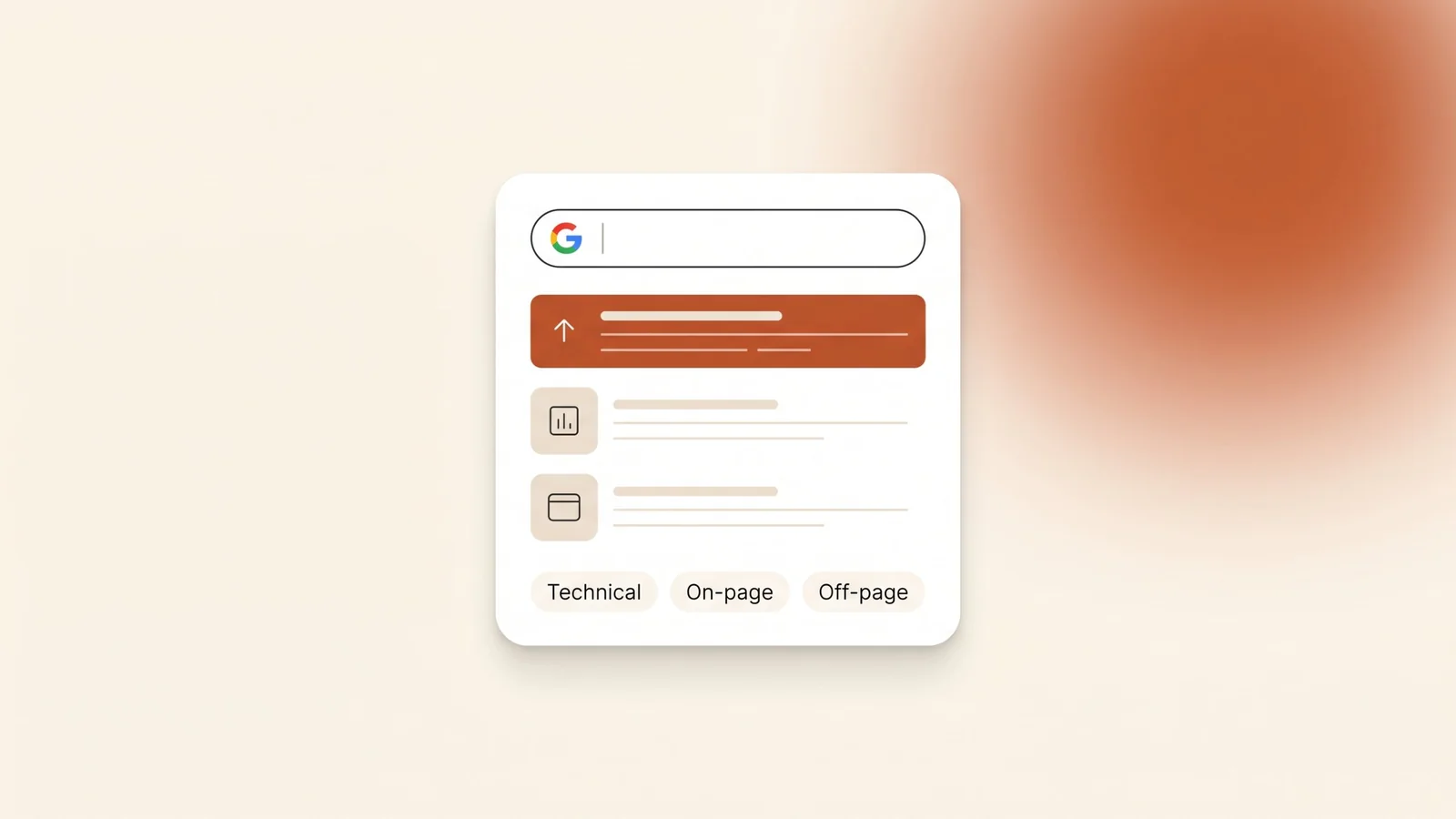
The short answer: SEO (search engine optimization) is the work that helps your website appear in Google’s organic results, the ones that are not ads. It has three parts: technical SEO, so Google can crawl and index your pages; on-page SEO, so each page answers what people search for; and off-page SEO, so links and reviews give Google reasons to trust you. Organic clicks are free, but results take months and nobody can guarantee a position.
What is SEO?
SEO stands for search engine optimization. It is the work that helps your website appear in Google’s organic results, the ones that are not ads. Google’s own SEO Starter Guide describes it as helping search engines understand your content and helping people decide whether to visit your site.
You cannot pay Google for an organic position. Google says it doesn’t accept payment to crawl a site more often or to rank it higher. The clicks you get from organic results are free. The work that earns them is not: it costs time, or it costs someone you pay to do it.
In practice, SEO is three things done together. Google must be able to reach and read your pages. Each page must answer what people search for. And other sites and sources must give Google reasons to trust you. The rest of this guide takes each one in turn.
How does Google decide which pages to show?
Google works in three stages: crawling, indexing and serving results. Its guide to how Search works explains each one.
- Crawling. Google’s crawler, Googlebot, finds pages and downloads them. Most pages are found through links from pages Google already knows.
- Indexing. Google reads each page and stores what it is about. Not every page makes it in. Google states that indexing isn’t guaranteed.
- Serving. When someone searches, Google picks the pages from its index that best answer the search. Relevance can depend on the searcher’s location, language and device.
That last point matters in Saudi Arabia. A person in Jeddah searching in Arabic on a phone can see different results from a person in Riyadh searching in English on a laptop. Your pages need to fit the searches your real customers make, in the language they use.
What are the three parts of SEO?
SEO is usually split into three parts. Each one solves a different problem.
| Part | The question it answers | Typical work |
|---|---|---|
| Technical SEO | Can Google crawl, index and understand the site? | Indexing, page speed, mobile layout, sitemaps, broken pages and redirects. |
| On-page SEO | Does each page answer what people search for? | Choosing the search for each page, writing the content, titles, meta descriptions, headings and internal links. |
| Off-page SEO | Do other sources give Google reasons to trust you? | Links from real websites, mentions, reviews and your Google Business Profile. |
The split is a way to organise the work. Google looks at the whole picture, not three separate scores.
A business that serves one city also needs local SEO: the work of making a business appear in Google search and Google Maps results for searches made in or about its city. Local SEO uses all three parts, plus a complete Google Business Profile.
What is technical SEO?
Technical SEO is the set of fixes that let Google crawl, index and understand a site, such as speed, mobile layout and indexing. If this part fails, nothing else counts, because Google can’t rank a page it can’t read.
Google’s technical requirements set the minimum. Googlebot must not be blocked from the page. The page must work, which means Google receives a success (200) status code, not an error. And the page must have content Google can index.
Beyond that minimum, the usual technical checks are:
- Indexing. Are your important pages in Google’s index? Pages blocked by mistake, or marked “noindex”, never appear.
- Mobile. Many of your customers search on a phone. The site has to read and work well on a small screen.
- Speed. A page that loads slowly on mobile data makes people wait. Our guide to website speed and Core Web Vitals covers what to measure.
- Clean URLs and redirects. One address per page, and old addresses redirected to new ones, not left as errors.
- A sitemap. A file that lists the pages you want Google to find.
What is on-page SEO?
On-page SEO is the work on the page itself. It starts with one decision: which search is this page for? A page for “commercial lawyer in Jeddah” and a page for “family lawyer in Jeddah” serve different people, so they should be different pages.
The content comes first. Google says its ranking systems are designed to prioritise helpful, reliable information created to benefit people, not content made to manipulate rankings. Write what your customer needs to know to decide: what you do, for whom, where, how it works and how to contact you.
Then the details that help Google and searchers read the page:
- The title. Google’s Starter Guide says a good title is unique to the page, clear and concise, and accurately describes the page.
- The meta description. A short summary, unique to the page, with its most relevant points. Google may show it under the title in the results.
- Headings. They make the page easy to scan. Google says there is no ideal number of headings.
- The URL. Words a person can read, not random numbers.
- Internal links. Links between your own pages help people and Google find related content.
Two myths to drop. Google doesn’t use the keywords meta tag. And the length of the content alone doesn’t matter for ranking, so there is no word count to hit. Write as much as the topic needs.
In Saudi Arabia, most businesses also need pages in Arabic. A translated English page often misses the words people actually type. Our guide to Arabic SEO covers how to handle both languages.
What is off-page SEO?
Off-page SEO covers the signals that come from outside your website. The biggest one is links. Google’s Starter Guide says the vast majority of new pages Google finds every day are found through links. A link from a relevant, real website also tells Google that someone else found your page worth pointing to.
Good links come from real relationships: suppliers, partners, industry associations, local directories and press that covers your field. Bought links are a risk. Google’s spam policies define link spam as creating links mainly to manipulate rankings, and buying or selling links for ranking purposes is the first example they give.
For local businesses, your Google Business Profile is the most important off-page asset. It is the free Google listing that controls how a business appears on Google Maps and in the local pack. Reviews, accurate details and regular updates all help. Our guide on how to rank on Google Maps in Saudi Arabia walks through it.
Keep your NAP the same everywhere: your business’s name, address and phone number, which must match everywhere they appear online.
How long does SEO take to work?
Longer than ads, and not on a fixed schedule. Google’s Starter Guide says some changes take effect in a few hours and others take several months. It suggests waiting a few weeks before you judge whether a change helped.
There are good reasons for the wait. Google has to crawl the new or changed page, index it, and compare it with every other page competing for the same search. A new site also starts with no links and no history.
This is why SEO suits businesses that can plan a few months ahead. If you need calls this week, ads are the faster route. Our post on SEO vs Google Ads explains when to use each.
What can SEO not do?
SEO cannot guarantee a position. Google states that no one can guarantee a #1 ranking on Google. Anyone who promises first place is promising something they don’t control.
SEO cannot fix a weak offer either. It brings people to your page. If the page doesn’t answer their question, or the service isn’t what they want, they leave.
And SEO is not a one-time job. Competitors publish new pages, Google updates its systems, and your own services change. A site that was done once and left alone slowly falls behind.
How do you start SEO on your own website?
You can do the first steps yourself. None of this is secret. Most businesses that hire an SEO specialist do it because they don’t have the time, not because the knowledge is hidden.
- Check that Google can see your site. Set up Google Search Console for your domain. It shows which pages are indexed and which have problems.
- List the searches that bring you customers. Write down your services and the cities you serve, and how a customer would type each one in Arabic and in English.
- Give each main search its own page. One page per service, written for the person searching, with a clear way to call, message or book.
- Write a real title and meta description for every page. Unique, clear and accurate. Not the business name repeated on every page.
- Fix the technical basics. Test the site on your phone. Check that it loads quickly and that no important page shows an error.
- Complete your Google Business Profile. Correct category, hours, phone number, photos, and a habit of asking happy customers for reviews.
- Earn links from real relationships. Ask partners, suppliers and associations you already work with to list or link to you.
- Measure and repeat. In Search Console, watch impressions (how often you appear) and clicks. Improve the pages that appear often but get few clicks.
Do these in order. A great page that Google can’t index brings nothing, so the technical check comes first.
Frequently asked questions
Is SEO free?
The clicks are free. Google doesn’t accept payment to rank a site higher, so you never pay per click for organic results. The work itself has a cost: your own time, or the fee of the person you hire to do it.
How long does SEO take to show results?
Google Business Profile and local fixes can show movement within weeks. Organic rankings typically show first movement in 2 to 4 months. The wait comes from Google needing time to crawl, trust and rank new work.
Can anyone guarantee first place on Google?
No. Google states that no one can guarantee a #1 ranking. Rankings depend on the search, the searcher and every competing page, and Google changes its systems over time.
What is the difference between SEO and local SEO?
SEO is the work that helps a website appear in Google’s organic results for any search. Local SEO is the work of making a business appear in Google search and Google Maps results for searches made in or about its city. It adds your Google Business Profile, reviews and consistent name, address and phone number.
Do I still need SEO if I run Google Ads?
Usually yes. Ads stop when the budget stops, while pages that rank keep bringing visits without a cost per click. Many businesses use ads for leads now and SEO for steady traffic later.
The bottom line
SEO is the work that helps your website appear in Google’s organic results. It has three parts: a site Google can crawl and index, pages that answer what your customers search for, and outside signals like links, reviews and a complete Google Business Profile. It takes months, nobody can guarantee a position, and pages that rank keep bringing visits after the work is done.
Kyvo Media does this work as part of our SEO service, in Arabic and English. Book a free audit and we’ll show you what is holding your site back in Google.