
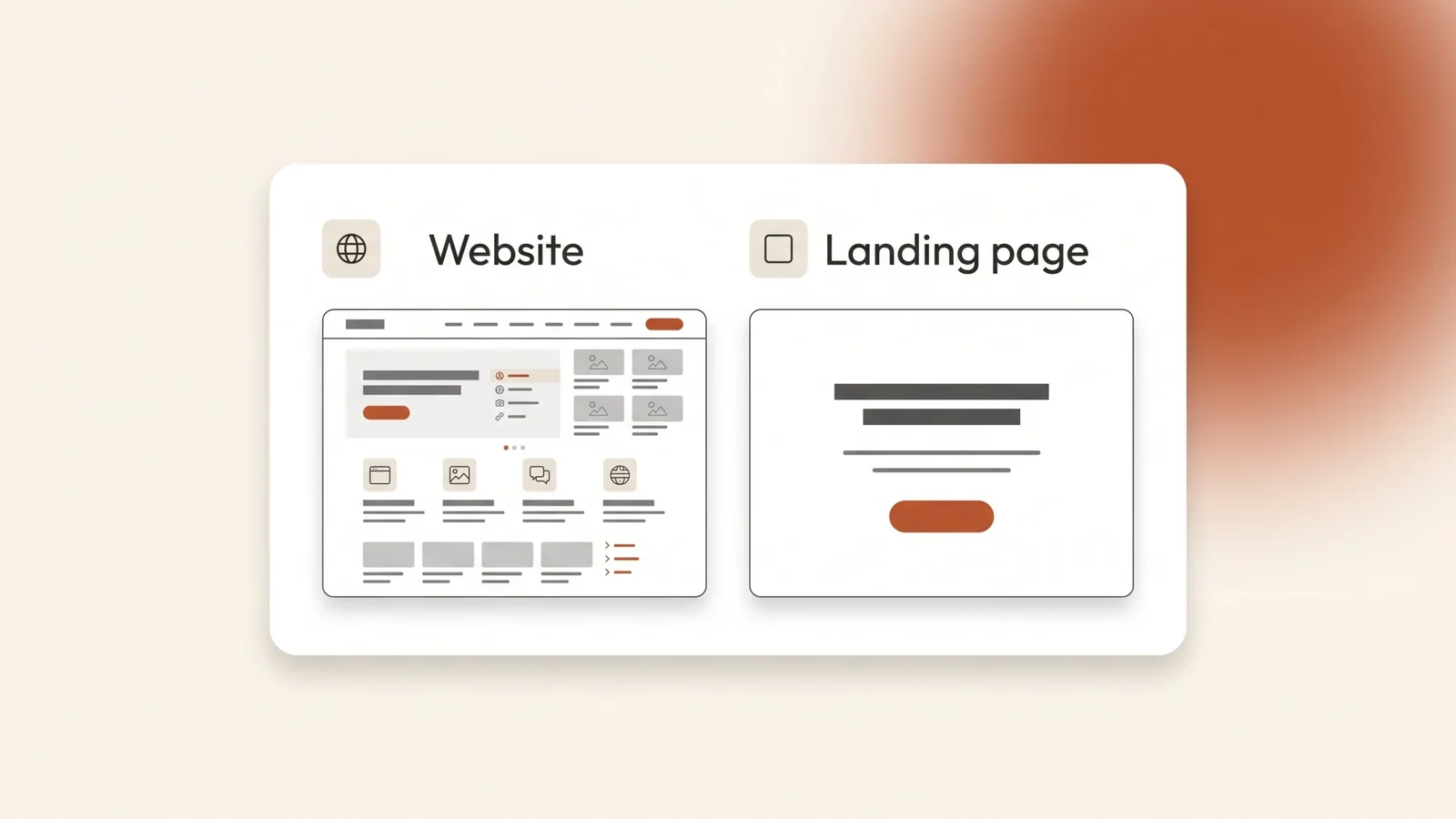
You have decided to run Google Ads. The next question is where each click should go. Most business owners choose between their existing website and a separate landing page. That choice decides how many clicks turn into calls, and it can change what each click costs.
The short answer: send each Google Ads click to a page built for that one ad: a dedicated landing page, or a focused service page on your website. Avoid the homepage. Google judges how relevant and useful the page is to the person who clicked, and that feeds into your ad's rank and cost. Use a separate landing page for one offer and one action. Use a service page when it already matches the search.
What is the difference between a landing page and a website?
In Google Ads, the landing page is the webpage where people end up after they click your ad. It is usually the same as the ad's final URL. So every ad already has a landing page. The real question is what kind of page it is.
There are three common options:
| Option | What it is | Navigation | Best for |
|---|---|---|---|
| Homepage | The front page of your website, covering everything you do | Full menu and many links | Searches for your business name |
| Service page | One page about one service, part of your website | The site menu stays | Searches for one service, when the page already answers them |
| Dedicated landing page | A standalone page built for one campaign or offer | Little or none, with one main action | One offer and one action, especially when the website is slow or outdated |
Our way of grouping the options. To Google, any of them is a landing page.
Why does the page after the click affect what you pay?
Google ranks ads in an auction, and your bid is only one part of it. Google lists the quality of your ads and landing page as a factor in Ad Rank, measured at auction time through expected click-through rate, ad relevance and landing page experience. Google also says higher quality ads can often lead to lower costs per click.
Google defines landing page experience as how relevant and useful your landing page is to people who click your ad. Your account shows it as one of the three parts of Quality Score, a 1 to 10 rating for each keyword. Google is clear that Quality Score itself is not an input in the ad auction. It is a diagnostic. A low landing page rating still tells you the page is holding your ads back.
In plain terms, a page that doesn't match the search loses you the customer, and it can make the click more expensive too.
When is a dedicated landing page the better choice?
A standalone landing page earns its place when the ad has one job:
- One offer or one service. A campaign for "commercial disputes lawyer Jeddah" or "dental implants Riyadh" needs a page about exactly that, and nothing else.
- One action. Call, WhatsApp or a short form. Taking away the full menu takes away the exits.
- A slow, old or hard-to-edit website. Building one fast page is quicker than fixing a whole site before launch.
- Seasonal campaigns. A Ramadan or National Day offer can have its own page without changing the main site.
- A clean measurement. When the page exists only for ads, all of its numbers come from ad traffic.
Google's own advice points the same way. It recommends choosing a landing page that closely matches your ad and keywords, and making it quick and easy for customers to take the action you want.
When is a page on your website enough?
You don't always need a separate page. A good service page on your website is already a landing page if it matches the search. Check four things:
- The page is about the one service in the ad, not a list of everything you do.
- The headline uses the same words as the ad.
- The call, WhatsApp or booking button is visible on a phone without scrolling.
- The page loads quickly on mobile data, not just on office Wi-Fi.
A service page has two advantages that a standalone landing page usually lacks. It can rank in normal Google results over time, so the work isn't paid for by ads alone. And the visitor can check the rest of your site before they call. In sectors where trust decides the call, such as legal, medical or real estate services, that extra look can matter.
If your service pages are thin or outdated, fix them first. Better service pages from a proper website development job serve your ads and your search rankings at the same time.
Why is the homepage usually the wrong destination?
The homepage is built for people who already know you. It talks about every service, your story and your team. Someone who searched for one service has to find it on their own, and on a phone many people won't. Google advises against making people hunt around for information, and suggests putting important information towards the top of the page.
There is one exception. When someone searches for your business name, the homepage is a sensible destination, because they are looking for you, not for a service.
Sending every ad to the homepage is one of the common Google Ads mistakes in a new account, and one of the easiest to fix.
What does a Google Ads landing page need?
Whether it is a standalone page or a service page, the same checklist applies. Most of it comes straight from Google's guidance on optimising ads and landing pages:
- A headline that matches the ad and the words people searched.
- The same call to action as the ad. Google says your landing page should mirror the call to action in your ad text.
- The important information near the top: what you do, for whom, and where.
- Useful, original information about the service. Google asks you to be clear about your product or service and what it does.
- Real proof. Google suggests adding reviews that show real opinions from other customers.
- Easy contact on mobile: tap to call, a WhatsApp button and a short form.
- Few distractions. Google advises against cluttering the page with too many ads or pop-ups.
- The language of the ad. If you advertise in Arabic and English, an Arabic ad should open an Arabic page.
Speed deserves its own line. Google calls improving landing page speed one of the best and easiest ways to get better results from mobile ads. It adds that in retail it has seen a one-second delay on mobile affect mobile conversions by up to 20 percent.
What can go wrong with a separate landing page?
A landing page is not a shortcut. Google's ads policy on insufficient original content covers destinations with little or no original content, pages that say "Under construction" or "Coming soon", and bridge pages whose only purpose is to send people to another site. A page with one line and a form gives Google little to judge, and gives the visitor little reason to trust you.
There are practical costs too:
- Two places to update. Every change to your services, hours or offer has to be made on the website and on the landing page.
- No search value. A page built only for ads and left out of your site's navigation usually won't bring visitors on its own.
- Separate tracking. The page needs the same call, WhatsApp and form tracking as the main site, set up and tested again.
- Copied pages. The same policy lists templates or pre-generated websites that provide duplicate content. Ten copies of one page with only the city name changed come close to that.
How do you know which page works better?
Measure it. Set up conversion tracking for calls, WhatsApp clicks and form submissions before you launch, and test each one. Then open the Landing pages page in your Google Ads account. It lets you evaluate how each page your ads send people to is performing, including how mobile-friendly it is for the people who click.
To compare a service page with a dedicated landing page, send the same keywords to each one after the other, and compare the cost per inquiry after a few weeks. Change one thing at a time, or you won't know which change made the difference.
Where to start
- List the services you want to advertise, one service per campaign or ad group.
- Check your website for a page that matches each one and shows a contact button on mobile without scrolling.
- If the page exists, use it as the final URL. Tighten the headline and check its speed on a phone.
- If it doesn't, build one dedicated landing page for that service, with real, original content.
- Set up and test tracking for calls, WhatsApp and forms.
- After a few weeks, review the Landing pages report and your cost per inquiry, then decide.
If you are still setting your budget, our guide to Google Ads cost in Saudi Arabia explains how cost per click is set.
Frequently asked questions
Is a landing page better than a website for Google Ads?
Not in every case. What matters is that the page matches the ad. A focused service page on your website can work as well as a separate landing page. The homepage is usually the weakest choice, except for searches for your business name.
Do I need a full website to run Google Ads?
No. A single landing page can be enough to start, as long as it has useful, original content about what you sell. Google's ads policies cover pages with little or no original content, so a page with only a form is a risk. A full website helps later with trust and search rankings.
Does the landing page affect my cost per click?
It can. Google lists the quality of your ads and landing page as a factor in Ad Rank, and says higher quality ads can often lead to lower costs per click. A relevant, useful page helps your ads compete without raising your bid.
Should the landing page be in Arabic or English?
In the same language as the ad. If you run ads in Arabic and English, give each language its own version of the page, so someone who clicked an Arabic ad lands on Arabic content.
How many landing pages do I need?
Start with one for each service or offer you advertise. If you serve several cities, only make separate city pages when the details really differ, not just the city name, because Google's policies cover duplicate template content.
The bottom line
The landing page vs website question rests on one rule: the page must answer the search that triggered the ad. A dedicated landing page does that well for one offer and one action. A strong service page on your website can do it too, and keeps working for search. The homepage rarely does. Whichever you choose, track it and let the numbers decide.
If you want us to look at your Google Ads and the pages they send people to, book a free audit and bring your main campaign.