
A customer in Riyadh sees your ad on Google, or scans a QR code on your flyer, or taps the link in your Instagram bio. The page that opens next decides what happens. If it answers their question and makes the next step easy, they call or fill in the form. If it doesn’t, they go back and pick someone else. That page is your landing page.
The short answer: A landing page is the page a visitor reaches after clicking an ad, link or QR code. In marketing, the term usually means a page built for one offer and one action, such as a call or a booking. A good landing page matches the ad that sent the visitor, explains the offer clearly, shows real proof, and makes contact easy on a phone. It is judged by how many visitors take that action.
What is a landing page?
The term has two meanings, and both are useful to know.
In Google Ads, the meaning is technical. Google defines the landing page as “the webpage where people end up after they click your ad.” It is usually the same as the ad’s final URL, the address you set for each ad. So every ad already has a landing page, even when that page is your homepage.
In marketing, the meaning is narrower. A landing page is a page built for one campaign, one offer and one action. It is not trying to tell the whole story of your business. It is trying to get one kind of visitor to take one step.
Ads are not the only source of visitors. A landing page can sit behind a QR code on a brochure, the link in a social media profile, a link in an email or SMS, or a WhatsApp broadcast. Wherever the click comes from, the job is the same.
How is a landing page different from a homepage?
A homepage serves everyone. A landing page serves one visitor with one need. The difference shows in almost every part of the page:
| Homepage | Landing page | |
|---|---|---|
| Visitor | Anyone: new customers, returning clients, job seekers, suppliers. | One kind of visitor, usually from one ad or campaign. |
| Goal | Show everything you do and help people find their way. | Get one action: a call, a WhatsApp message, a booking or a form. |
| Links | A full menu and many links to other pages. | Few links, often a short menu or none, so the visitor isn’t pulled away. |
| Content | A summary of all your services. | Full detail on one service or offer. |
| Headline | About your business. | About the visitor’s need, in the words they searched or clicked. |
A focused service page on your website can do the job of a landing page when it matches the ad.
Whether to send ads to a separate landing page or a page on your website is its own decision. Our guide on landing page vs website for Google Ads walks through it.
What are the main types of landing pages?
Landing pages are grouped by the action they ask for. These are the types most Saudi businesses use:
- Lead page. The visitor leaves their name and phone number through a short form. Used by law firms, real estate agents, contractors and B2B services.
- Booking page. The visitor picks a time for a visit, a consultation or a test drive. Used by clinics, salons and car services.
- Click-to-call or WhatsApp page. The main button opens a phone call or a WhatsApp chat. Suits services where customers want to talk before they decide.
- Product or offer page. One product or package with its details and a buy or order button. Used by online stores for a campaign or a best seller.
- Seasonal or event page. A page for one period, such as Ramadan, Eid, National Day or a sale, removed or updated when the period ends.
One page should do one of these. A page that asks for a form, a booking, a call and a purchase at once gives the visitor four decisions instead of one.
What does a good landing page need?
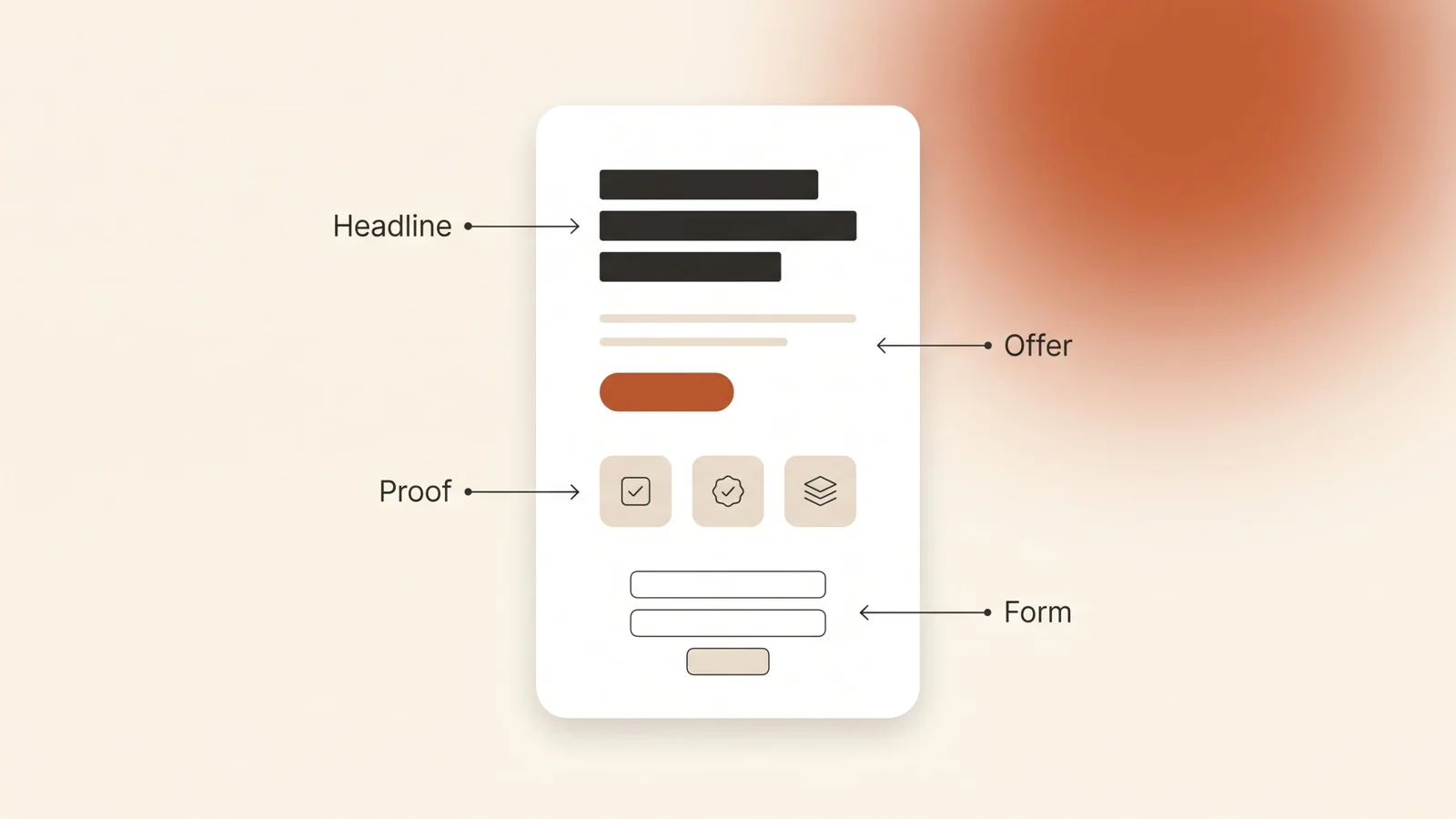
Most strong landing pages are built from the same parts, in roughly this order. Much of it comes straight from Google’s advice on optimising ads and landing pages.
- A headline that matches the click. If the ad says “Commercial lawyer in Jeddah”, the headline says the same. Google recommends choosing a landing page that closely matches your ad and keywords. The visitor should know within seconds that they are in the right place.
- The offer, near the top. What you do, for whom, where, and what happens when they contact you. Google suggests putting important information towards the top of the page.
- Useful, original detail. Explain the service properly: what is included, how it works, how long it takes. Google asks advertisers to provide useful, original information about whatever they are advertising.
- Proof. Real reviews, photos of real work, licences and the years you have been working. Google suggests adding reviews that show real opinions from other customers. Never invent them.
- One clear action, repeated. The same button near the top, in the middle and at the end. Google says your landing page should mirror the call to action in your ad text.
- A short form or a direct contact button. Tap to call, a WhatsApp button, or a form with as few fields as you can manage.
- Answers to the usual questions. A short FAQ deals with the doubts that stop people calling: location, working hours, what to bring, how payment works.
Two more things apply to the whole page. First, the phone. Google notes that many of your customers will visit on a mobile device, and advises keeping the mobile page quick, easy to contact you from and simple to navigate. Our guide to website speed and Core Web Vitals shows how to measure speed. Second, the language. An Arabic ad should open an Arabic page, written for Arabic readers and laid out right to left, not an English page with a translated headline.
What should the form ask for?
Every field you add is one more reason to leave. For most service businesses, three fields are enough: name, phone number and the service they need. Ask for anything else on the first call.
Tell the visitor what happens after they send it. “We’ll call you within working hours” or “You’ll get a WhatsApp reply” sets an expectation and builds trust. Then keep the promise. A lead that waits a day for a reply has often called a competitor by then.
A form collects personal data, so be clear about it. SDAIA’s guide to the Saudi Personal Data Protection Law says individuals have the right to be informed about the lawful basis for collecting their personal data, and should be told the purpose. A short line under the form, with a link to your privacy policy, does that. For anything beyond that, ask your lawyer.
How does Google Ads judge a landing page?
When the page is the destination of an ad, Google rates it. Google describes landing page experience as a measure of how relevant and useful your landing page will be to people who click your ad. It says landing pages with higher ratings are usually well organised and have text that relates to a person’s search terms.
Landing page experience is one of the factors behind each keyword’s Quality Score. Google’s tips for it are short: make the information useful and relevant to the ad, keep the page easy to navigate, limit the number of links, and meet the expectations the ad set up.
Google also sets rules the page must follow. Your landing page and display URL need to be on the same domain. And Google’s policy on insufficient original content covers destinations that offer little real value, including pages that say “Under construction” or “Coming soon”, bridge pages that only link to other sites, and templates that provide duplicate content. A page with one line and a form is a risk. So are ten copies of one page with only the city name changed.
How do you know if a landing page works?
A landing page is measured by its conversion rate. In Google Ads, Google defines conversion rate as the average number of conversions per ad interaction, shown as a percentage. Its example: 50 conversions from 1,000 interactions is a 5% conversion rate.
A conversion is the action you chose: a form sent, a call, a WhatsApp click or a booking. To count them, you need tracking on every one of those actions, tested before launch. Our guide to Google Ads conversion tracking shows how to set it up.
Then improve one thing at a time. Change the headline, or the form, or the main button, and compare the results over a few weeks. If you change three things at once, you won’t know which one made the difference.
Look past the rate as well. A page that brings many form fills from people outside your city, or for services you don’t offer, has a targeting or wording problem. Check the quality of the leads, not only the count.
What mistakes do landing pages often make?
- A headline about you, not the visitor. “Welcome to our company” tells the visitor nothing about their problem.
- Too many choices. A full menu, five services and three different buttons pull the visitor in different directions.
- A form that asks too much. National ID, email, company size and a long message before the first conversation.
- No proof. Claims with nothing behind them: no reviews, no photos of real work, no address.
- Slow on mobile data. Large images and heavy scripts that load fine on office Wi-Fi and slowly on a phone.
- The wrong language. An Arabic ad that opens an English page, or an Arabic page that reads like a machine translation.
- Broken or untested contact. A WhatsApp button with the wrong number, or a form that sends leads to an inbox nobody reads.
How do you build your first landing page?
- Pick one offer. One service, one audience, one city or region.
- Pick one action. A call, a WhatsApp message, a booking or a short form.
- Write the headline in your customer’s words. Use the words they search for and the words in your ad.
- Write the body. What you offer, how it works, what it includes, and the answers to the questions customers ask you on the phone.
- Add real proof. Reviews, photos of your work, licences, your address.
- Build the Arabic and English versions if you advertise in both languages, each written for its reader.
- Set up and test tracking for every form, call and WhatsApp button.
- Test it on a phone on mobile data, then launch and review the numbers after a few weeks.
Frequently asked questions
What is the difference between a landing page and a website?
A website is a set of pages that covers your whole business. A landing page is one page built for one offer and one action. A landing page can sit on its own or be part of your website, such as a focused service page.
Do I need a landing page if I already have a website?
Not always. If your website has a clear page for the service you advertise, with a contact button visible on a phone, that page can be your landing page. Build a separate one when the offer is new, seasonal or not covered well on your site.
Can a landing page rank on Google?
It can, if it has enough useful content, is linked from your website and Google can index it. A thin page built only for ads, with no links pointing to it, usually won’t bring visitors from search on its own.
How many fields should a landing page form have?
As few as you can manage. For most service businesses, name, phone number and the service needed are enough. Ask everything else on the first call.
Should a landing page have a menu?
A short one or none. Google’s tips for landing page experience include keeping the page easy to navigate and limiting the number of links. Keep only the links that help the visitor decide, such as your reviews, location or privacy policy.
The bottom line
A landing page is the page a visitor lands on after a click. The useful kind is built for one offer and one action: it matches the ad, explains the offer, shows real proof and makes contact easy on a phone. Measure it by conversion rate, check the quality of the leads, and improve one thing at a time.
Kyvo Media builds landing pages and service pages in Arabic and English as part of our website development service, and connects them to your Google Ads campaigns with tracking in place. Book a free audit and we’ll review the page your ads send people to.