
Most service businesses in Saudi Arabia describe what they do, not what the customer gets. “Quality service at competitive prices” appears on thousands of shop signs, ads and websites, and it gives the customer no reason to pick you over the next result on Google. An offer fixes that. It is a short, specific promise that tells the right customer what they will get, how soon, how much work it takes on their side and why it is safe to say yes.
The short answer: To create an offer for your business, start with one customer and one problem. Name the result they want in their own words. Add proof that you can deliver it. Then make the result faster to reach, easier for the customer and less risky to try, with a clear scope, one next step and a promise you can keep. A discount is not an offer. Value is.
What is an offer?
An offer is everything a customer gets when they say yes to you, written as one clear package. It includes the result, what is included, how long it takes, what the customer has to do, the price and what happens if it does not work. A service is what you do. An offer is what the customer gets from it.
Compare two lines for the same AC repair company. “AC maintenance services in Jeddah” describes a service. “Your AC repaired the same day in north Jeddah, with the fault and the price explained before any work starts” is an offer. The second line answers the questions the customer was going to ask anyway.
Why a good service is not enough
Customers cannot judge your skill before they buy. They judge what they can see: how clear the result is, how believable it sounds, how fast it comes and how much risk they are taking. When two businesses look the same, the customer falls back on price. A clear offer gives them something other than price to compare.
This matters most when you pay for attention. In Google Ads you pay for every click, so a vague offer costs you twice: once for the click, and again when the visitor leaves without calling. Our guide to common Google Ads mistakes explains why “free consultation” makes a weak hook.
The four parts that make an offer worth more
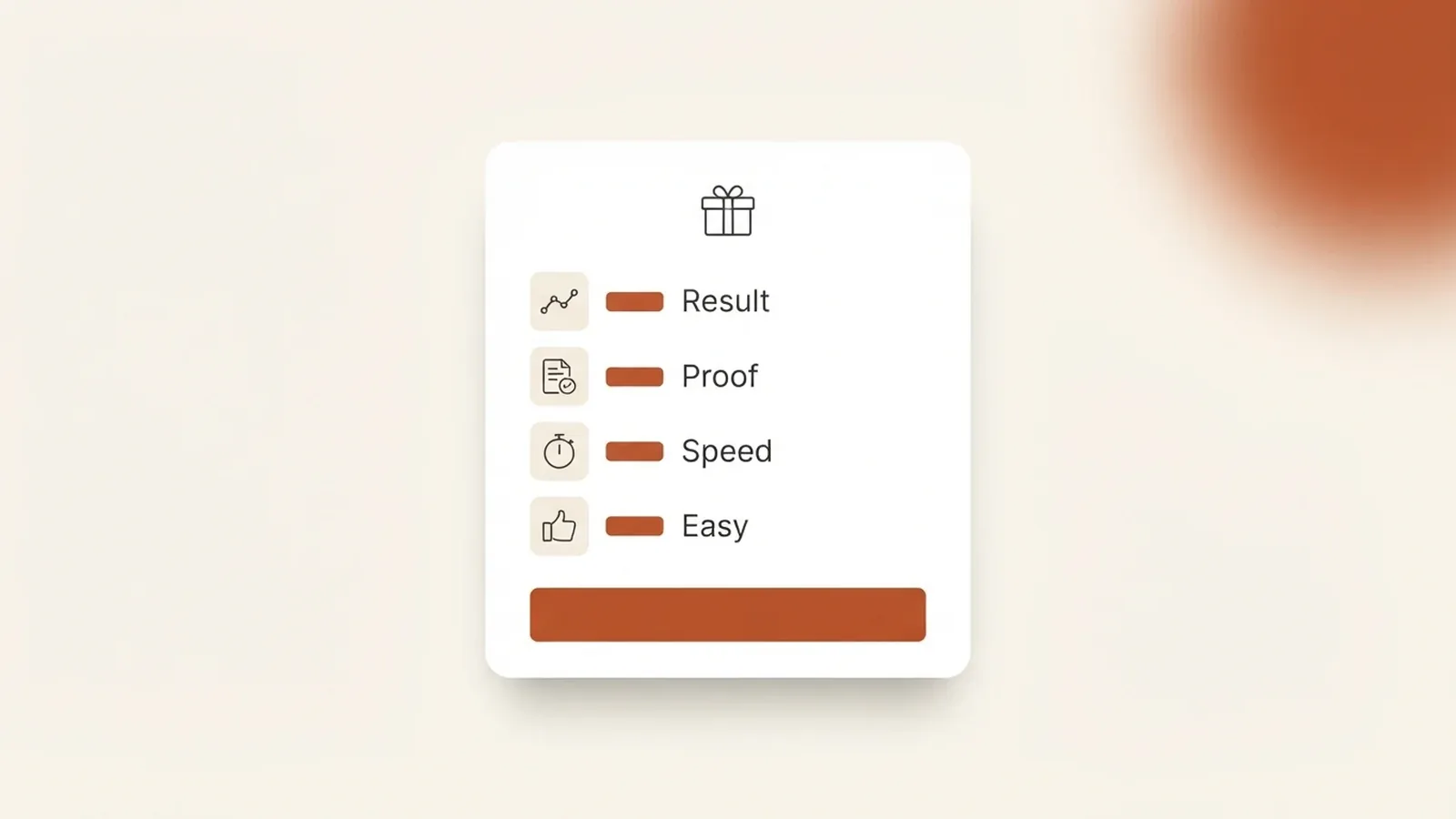
In his book $100M Offers, Alex Hormozi breaks value into four parts that he calls the value equation. His own pricing and value checklist sums it up as four moves: increase the dream outcome, increase the perceived likelihood of success, reduce the time to success, and reduce the effort and sacrifice. In plain words, a customer values your offer more when:
- The result is bigger, or matters more to them.
- They believe it will actually happen for them.
- It comes sooner, or they can see progress early.
- It takes less work, time and hassle on their side.
Most businesses only work on the first part. They describe the result and stop there. The steps below work through all four, then add the risk and the next step.
| Part | The question to ask | Example for a home cleaning company |
|---|---|---|
| Result | What does the customer actually want? | A clean home before the guests arrive, not “cleaning hours” |
| Belief | Why should they believe you? | Google reviews from real customers, photos of real jobs, a named supervisor |
| Speed | How soon will they see something? | Booking confirmed within the hour, the team at the door the same day or the next |
| Effort | What can you take off their plate? | The team brings all supplies, payment by card or transfer, no need to be home |
Illustrative example, not a real company.
Step 1: Pick one customer and one problem
An offer written for everyone convinces no one. Pick the customer you want more of and the problem that makes them look for you. A law firm’s offer to a company with an unpaid invoice is different from its offer to a tenant in a rental dispute, even if the same lawyer handles both. If you have not written this down yet, start with our guide on how to find your target audience.
Step 2: Name the result in the customer’s words
Write the result the way the customer would say it to a friend. Customers rarely want “digital solutions” or “comprehensive maintenance”. They want the shop full at the weekend, the car back before Thursday, the contract signed without surprises. Listen to how customers describe their problem on calls and in WhatsApp messages, and reuse their words.
Make the result specific and honest. “More customers” is vague. “Your car serviced and back before the end of the day” is specific. Only promise what you control. You can promise a delivery date. You usually cannot promise a customer’s sales figures.
Step 3: Show why they can believe it
Belief comes from proof the customer can check. Good proof for a small business includes Google reviews, photos of real work, your commercial registration or licence, the years you have been operating and a clear description of how you work. A step-by-step process is proof too, because it shows you have done this before.
Never invent proof. Made-up reviews, client counts or results break trust the moment someone questions them. Use only what is true today, and add more as you earn it.
Step 4: Make the result come sooner
Time is part of the price. A customer who waits three weeks for a result feels the cost every day. Look for ways to deliver part of the result early: a same-day visit, a first draft within 48 hours, a plan on the first call. When the full result takes time, show progress along the way with a short weekly update or a checklist of what is done.
Step 5: Make it easier for the customer
List every task the customer has to do to get the result, then remove as many as you can. Collect the documents for them. Bring the materials. Offer a WhatsApp number instead of a form with ten fields. Accept the payment methods they already use. Each task you remove makes the offer worth more without changing the result.
Step 6: Lower the risk of saying yes
Every purchase carries a risk: the money, the time and the embarrassment if it goes wrong. You lower that risk by making the scope and the outcome clear in advance. Practical ways to do it:
- A written scope: what is included, what is not, and the delivery date.
- A guarantee you can keep, with its conditions written down. For example, a free return visit if the same fault comes back within a set period.
- A small first step: a paid trial, a single session or one product before a larger order.
- A clear price before work starts, so the invoice never surprises the customer.
Write the guarantee so it is easy to understand and easy to honour. A guarantee you cannot keep turns a lost sale into an angry customer.
Step 7: Give it a name and one next step
Give the offer a short, plain name that says what it is, such as “Same-Day AC Repair” or “Monthly Office Cleaning Plan”. Then end with one clear action: call, send a WhatsApp message or book a time. If you list three actions with equal weight, many people pick none of them.
Weak offers and stronger offers
| Business | Weak offer | Stronger offer |
|---|---|---|
| Car service centre | Full car maintenance at competitive prices | Oil and filter changed while you wait, in under an hour, with the price shown before we start |
| Accounting office | Professional accounting services | Your monthly books closed by the 10th, with your VAT return prepared and a short report in Arabic or English |
| Home cleaning | Best cleaning company in Riyadh | Your home cleaned the day before your guests arrive, the team brings everything, and we come back free if we missed something |
| Law firm | Legal consultation services | A written review of your commercial contract within 3 working days, with each risk explained in plain Arabic |
Illustrative examples. Only promise what your business can actually deliver.
Is a discount an offer?
A discount changes the price, not the value. It can help fill a quiet month, but a business that competes on discounts alone teaches customers to wait for the next one. Build the offer first, and use a discount as a short, planned event on top of it.
In Saudi Arabia, discounts also come with rules. The Ministry of Commerce says a business or online store must apply for a permit before it announces price reductions, and must display that permit clearly to customers. Its nine rules for sales discounts also require the discount percentage to be shown clearly, a tag with the original and discounted price on each discounted product, and the return and exchange policy to be communicated during the sale. Discounts must be real, and the ministry says violators face fines under the Anti-Commercial Fraud Law. Get the permit before you advertise any sale.
Where to use your offer
Once the offer is written, use the same words everywhere a customer meets you:
- Your landing page headline and first screen. Our guide on what a landing page is shows how to build one around a single offer.
- Your Google Ads headlines and descriptions.
- Your Google Business Profile description and posts.
- Your WhatsApp greeting and the first reply your team sends.
- Your marketing plan, as the message in our one-page marketing plan.
If the ad says one thing and the page says another, the customer stops trusting both.
Common mistakes
- Listing features instead of results. “Ten years, modern equipment, qualified team” is proof, not the offer. Lead with the result and use these points to back it up.
- Writing the offer for everyone. A broad offer is easy to ignore.
- Promising what you do not control. Promise what you deliver, such as a date or a standard, not the customer’s own results.
- Hiding the conditions. A price or guarantee with hidden conditions creates complaints.
- Never testing it. Try two versions of the headline in your ads or on your page, and keep the one that brings more enquiries.
Frequently asked questions
What is the difference between an offer and a service?
A service is what you do. An offer is the complete package the customer gets: the result, what is included, how soon, what they have to do, the price and what happens if it does not work. Two businesses can sell the same service with very different offers.
Should my offer include a discount?
It does not have to. A discount changes the price, not the value. Build the offer around the result, proof, speed and ease first. If you run a discount in Saudi Arabia, the Ministry of Commerce requires a permit before you announce it.
Do I need a guarantee in my offer?
No, but lowering the risk helps. A written scope, a clear price before work starts or a small first step can do the same job. If you offer a guarantee, write its conditions clearly and only promise what you can honour.
How do I know if my offer is working?
Count the enquiries it brings and how many become paying customers, before and after you change it. Change one thing at a time, such as the headline or the guarantee, so you can see what made the difference.
How often should I change my offer?
Keep the core offer stable for at least a few months so you can measure it. Review it when enquiries drop, when competitors copy it or when you add a new service.
The bottom line
An offer is a clear promise to one customer about one result. Make the result specific, back it with real proof, make it come sooner and take less effort, and lower the risk of saying yes. Then use the same words in your ads, on your page and in your WhatsApp replies.
Kyvo Media helps Saudi businesses shape their offer and put it in front of the right customers through our digital marketing service. Book a free audit and we’ll review how your offer reads today on your website, your ads and your Google Business Profile.