
Most small businesses in Saudi Arabia market by reaction. A quiet month leads to a few boosted posts, a busy month means nothing gets done, and a new agency pitch changes the direction again. A marketing plan stops that cycle. It does not need to be long. One page that says what you want, who you want it from, what you will say, where you will say it and how you will know it worked is enough to run a small business for a year.
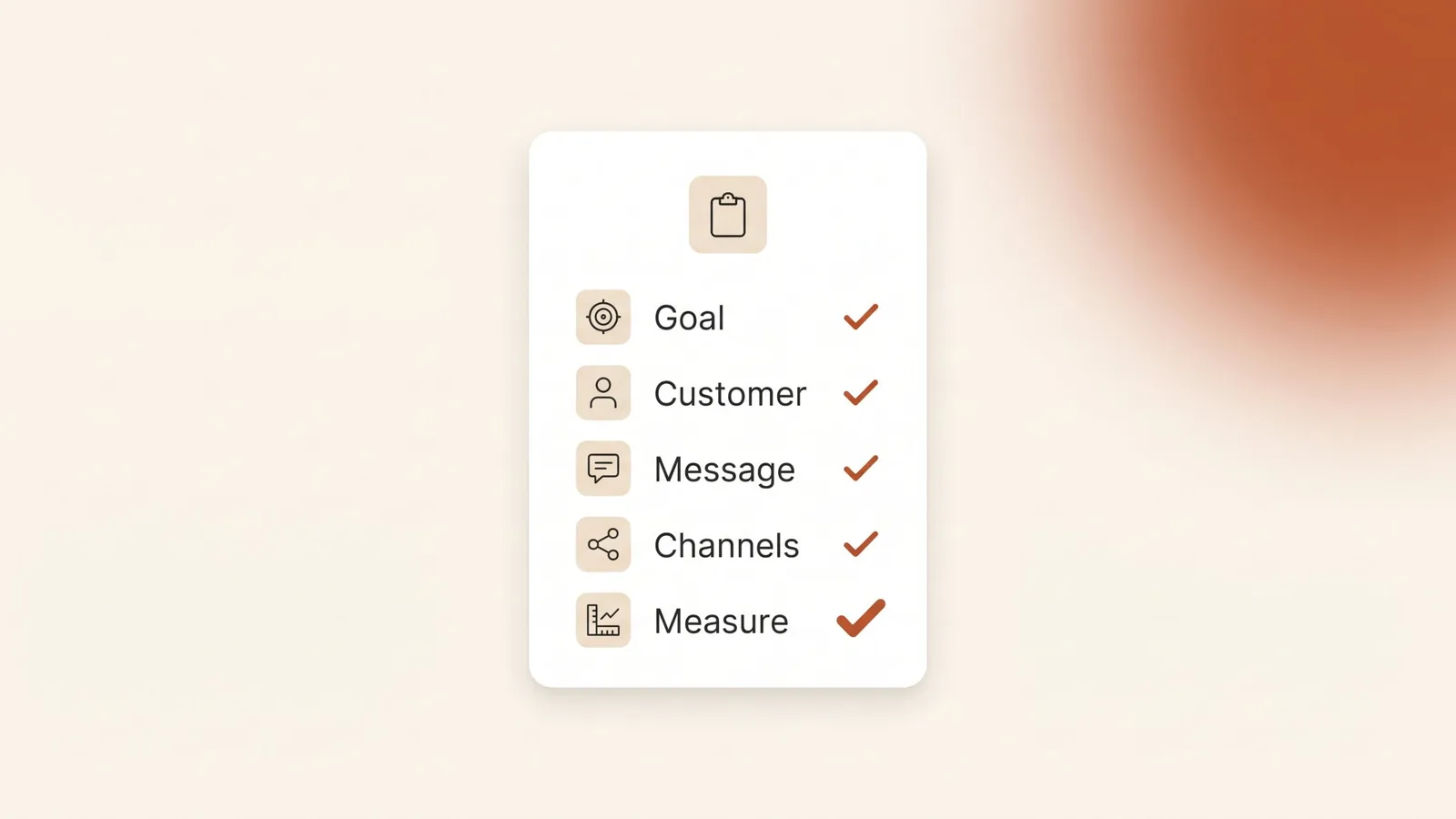
The short answer: To make a marketing plan for a small business, write one page with five parts. Set one goal you can count, such as enquiries per month. Describe the customer you want more of. Write the message that matches their problem. Pick two or three channels you can run properly, with a budget and a time frame for each. Then decide which numbers you will check every month, and review the plan every 90 days.
What is a marketing plan?
A marketing plan is a short written document that says how a business will get new customers over a set period. It names the goal, the customer, the message, the channels, the budget and the numbers used to measure progress. A large company may write fifty pages. A small business needs one page that the owner and the team actually read.
In Saudi Arabia, the Small and Medium Enterprises General Authority (Monsha’at) classifies a small enterprise as one with 6 to 49 full-time employees or annual revenue above SAR 3 million and up to SAR 40 million, according to its enterprise classification. A business at that size, or a micro business below it, rarely has a marketing department. That is exactly why the plan has to be simple enough to run alongside everything else.
Before you start: write down where customers come from today
A plan starts from where you are, not from where you wish you were. Before you write a goal, spend one hour on these questions and write the answers down:
- How many enquiries did you get last month? Calls, WhatsApp messages, form submissions and walk-ins, counted together.
- Where did they come from? Google search, Google Maps, Instagram, a referral, a returning customer. If you don’t know, start asking every new enquiry “how did you hear about us?” today.
- How many became paying customers? Even a rough count is useful.
- What are you already paying for? Ads, a website, a designer, a listing on a directory.
If most of these answers are “I don’t know”, the first goal of your plan is to find out. A business that cannot count its enquiries cannot tell whether any marketing is working.
Step 1: Set one goal you can count
A goal is a number, a deadline and a source. “Grow the brand” is not a goal, because nobody can tell whether it happened. “Get 40 enquiries a month from Google search and Google Maps by the end of March” is a goal, because you can count it every week.
Pick one main goal for the next 90 days. Small businesses usually choose one of these:
- More enquiries: calls, WhatsApp messages or form submissions.
- More bookings: appointments, visits or consultations actually booked.
- More sales: orders, for an online store.
- Better enquiries: fewer people asking for things you don’t sell, more asking for your most profitable service.
Base the number on last month’s count from the step above. A goal far above where you are today usually leads to spending too fast and giving up too early.
Step 2: Describe the customer you want more of
Write two or three sentences about the customer this plan is for. Say who they are, what problem makes them look for you, where they are, which language they search in and where they look for a solution. Focus on the customers you want more of: the ones who paid well, came back and were easy to work with.
If you have more than one type of customer, pick the most valuable one for this plan and leave the rest for the next 90 days. Our guide on how to find your target audience walks through this step in detail, with a one-page profile you can copy into the plan.
Step 3: Write the message
The message is what you want the customer to understand about you in a few seconds. Write it in three short lines:
- The problem: what the customer is dealing with, in their words. “Your AC stopped cooling in the middle of summer.”
- What you offer: what you do about it and where. “Same-day AC repair across north Jeddah.”
- Why they can trust you: proof that is true and specific, such as your years in business, your Google reviews, a licence or a guarantee you actually give.
Use the same message everywhere in this plan: on your website, your Google Business Profile, your ads and your social posts. A customer who sees one thing in an ad and another on your website loses confidence. Never use proof you cannot back up. Invented numbers or reviews damage trust faster than having none. To turn the message into a full offer, read our guide on how to create an offer for your business.
Step 4: Pick two or three channels
A channel is a place where your customer can find you. A small business with limited time does better with two channels run properly than with six run badly. Choose the channels that match where your customer looks, which you worked out in Step 2.
| Channel | Best for | When results start | What it needs from you |
|---|---|---|---|
| Google Business Profile | Local businesses that customers visit or call | Often within weeks | Complete details, photos, regular reviews |
| Search engine optimization | Services people search for on Google | Usually months | A good website, useful pages, patience |
| Google Ads | Urgent needs and services with clear demand | From launch | A daily budget, a landing page, tracking |
| Social media | Visual products, food, beauty, events | Varies widely | Regular posting, photos and video |
| WhatsApp and referrals | Returning customers and word of mouth | Quickly, if you ask | A habit of following up and asking |
Timings are general patterns, not promises. Results depend on the market, the competition and how well each channel is run.
For most local service businesses, the Google Business Profile is the first channel to fix, because it is free and it controls how you appear on Google Maps. Our guide on how to rank on Google Maps in Saudi Arabia covers it step by step. If you are choosing between search engine optimization and paid ads, our comparison of SEO vs Google Ads for Saudi businesses explains when each one makes sense.
Step 5: Set the budget and the time you will give it
Every channel costs money, time or both. Write down, for each channel, how much you will spend per month and how many hours you or your team will give it per week. Be honest about the hours. A plan that needs ten hours a week from an owner who has two will not happen.
If one of your channels is Google Ads, understand how the budget works before you set it. You set an average daily budget, not a fixed one. Google says a campaign might spend up to twice your average daily budget on a given day, but over a month it will spend no more than 30.4 times that daily amount. So the number you plan for is the daily budget multiplied by 30.4, not by the number of days you expect ads to run.
Give each channel enough time before you judge it. Ads can show signs within a few weeks once tracking works. Search engine optimization takes months. A plan that switches channels every two weeks never learns which one works.
Step 6: Decide how you will measure it
Pick the numbers you will check every month and write down where each one comes from. Keep the list short. These free Google tools cover most of what a small business needs:
- Google Business Profile performance. The report shows calls, messages, website clicks, direction requests and the searches people used to find your business, among other metrics. Only the metrics that apply to your business appear.
- Search Console. Its Performance report shows clicks, impressions, click-through rate and average position for your site in Google Search. Our Google Search Console setup guide shows how to set it up.
- Google Ads conversions. If you run ads, count calls, forms and WhatsApp clicks as conversions, not just clicks. Our guide to Google Ads conversion tracking covers the setup.
- Your own enquiry sheet. One row per enquiry: date, source, what they asked for, and whether they became a customer. No tool replaces this.
The number that matters most is the one in your goal. Everything else explains why it went up or down. To see which step between a first view and a paying customer loses the most people, read our guide on what a marketing funnel is.
Turn it into a 90-day calendar
A plan without dates stays a document. Break the next 90 days into three months and give each one a clear job:
- Month 1: fix the basics. Start counting enquiries and their source. Complete your Google Business Profile. Make sure your website states the message from Step 3 and has a clear way to call or message you.
- Month 2: run the channels. Launch the two or three channels you chose, with tracking in place from day one. Ask every happy customer for a Google review.
- Month 3: review and adjust. Compare your enquiry count with the goal. Put more time or money into the channel that brought the best customers, and fix or drop the one that brought none.
At the end of the 90 days, write the next plan on a new page. Keep the old one, so you can see what changed.
An example one-page plan
Here is what a filled-in plan can look like for a small home services company. It is an illustration of the format, not a real company or real results.
| Part | What goes in it | Example |
|---|---|---|
| Goal | One number, a deadline and a source | 40 enquiries a month from Google search and Maps by the end of the quarter |
| Customer | Who, problem, place, language | Homeowners in north Jeddah whose AC stops cooling, searching in Arabic on their phone |
| Message | Problem, offer, proof | AC not cooling? Same-day repair in north Jeddah, with real customer reviews on Google |
| Channels | Two or three, with budget and hours | Google Business Profile (2 hours a week), Google Ads with a set daily budget, WhatsApp follow-up |
| Measure | Numbers and where they come from | Calls and messages in the Business Profile report, ad conversions, the enquiry sheet |
Illustrative example only. The figures are a format guide, not a benchmark.
Common mistakes
- Starting with the channel. “We need TikTok” comes before knowing who the customer is. The channel should come from the customer, not the other way round.
- Setting a goal you can’t count. Awareness and engagement are hard to connect to income. Enquiries and bookings are not.
- Doing everything at once. Six half-run channels cost more and teach less than two run properly.
- Sending traffic to a weak page. Ads and posts that lead to a slow or confusing page waste the budget. Our guide on what a landing page is explains what a page needs to turn a visit into an enquiry.
- Never reviewing it. A plan written once and left in a drawer is a wish. Put the 90-day review in your calendar the day you write it.
Frequently asked questions
How long should a small business marketing plan be?
One page is enough for most small businesses. It should cover the goal, the customer, the message, the channels with their budget and time, and the numbers you will check. If it does not fit on one page, it is usually trying to do too many things at once.
How much should a small business spend on marketing?
There is no single right amount. Start from your goal and the channels you chose, then set an amount you can keep paying for at least three months without stopping. A smaller budget held steady teaches you more than a large one that runs out in two weeks.
How often should I update my marketing plan?
Check the numbers every month and rewrite the plan every 90 days. Update it sooner if you add a service, open in a new city or see a sharp change in enquiries.
Can I make a marketing plan without a website?
Yes. You can start with a Google Business Profile, WhatsApp and referrals. A website becomes important once you want to rank in Google search or run Google Ads, because both need a page to send people to.
What is the difference between a marketing plan and a marketing strategy?
The strategy is the decision about who you serve and why they should choose you. The plan is the list of actions, channels, budgets and dates that put that decision into practice. In a one-page plan for a small business, the customer and message sections hold the strategy.
The bottom line
A marketing plan for a small business is one page and five decisions: one goal you can count, one customer you want more of, one clear message, two or three channels with a budget and time, and a short list of numbers to check each month. Write it, run it for 90 days, review it, then write the next one.
Kyvo Media builds and runs marketing plans for Saudi businesses through our digital marketing service, starting with the goal and the customer before any channel is chosen. Book a free audit and we’ll review where your enquiries come from today and what to put in your first 90 days.