
Most business owners in Saudi Arabia judge their marketing by one number: how many new customers came in this month. When that number drops, they change everything at once. A marketing funnel gives you a better view. It splits the path from stranger to customer into a few stages, so you can see which stage is losing people and fix that one instead of guessing.
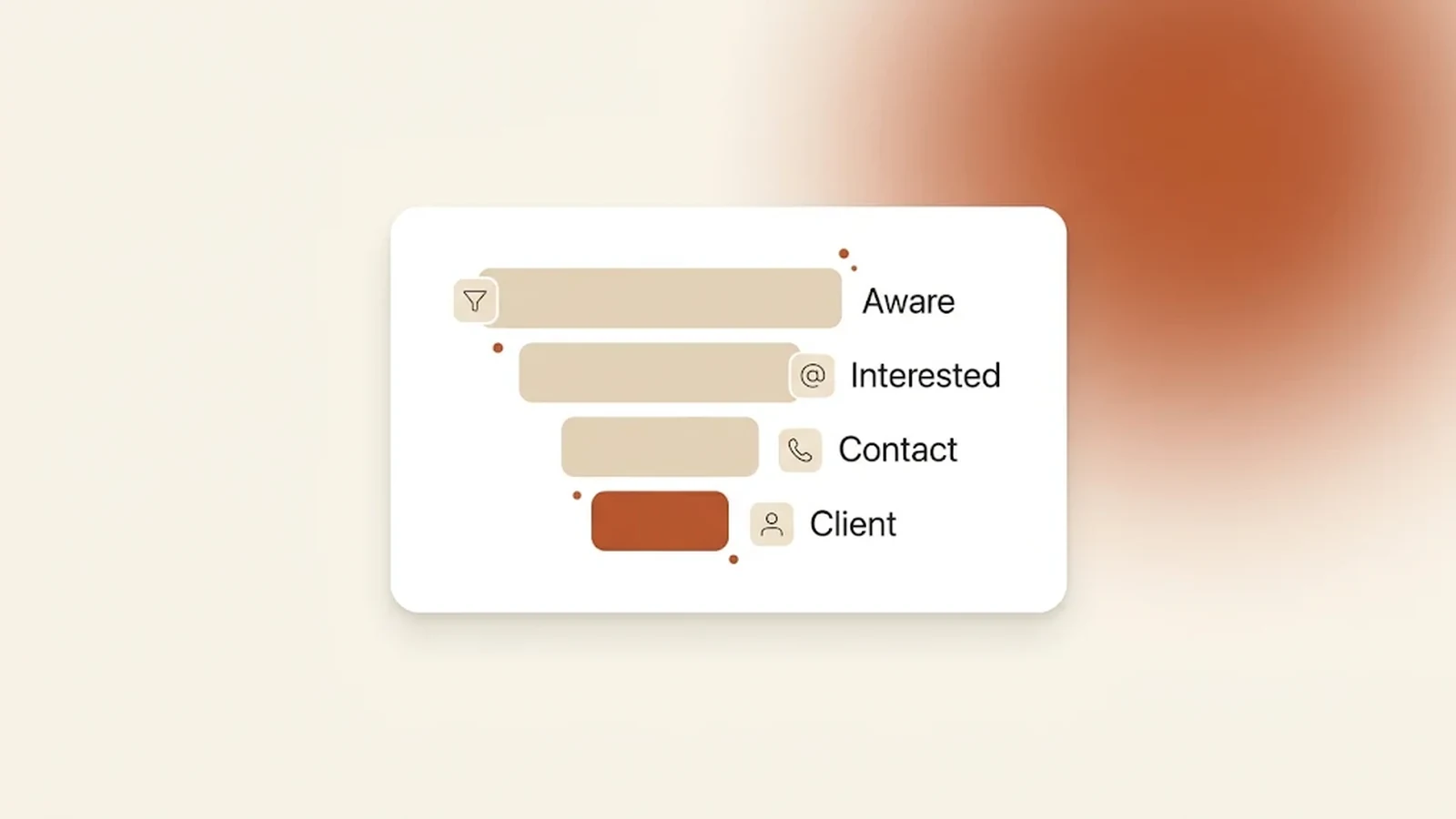
The short answer: A marketing funnel is the path a person takes from first hearing about your business to paying you. For a small business it has four stages: they become aware of you, they get interested and compare, they contact you, and they become a client. Fewer people reach each stage than the one before, which is why it is drawn as a funnel. Count each stage, find the biggest drop, and fix that step first.
What is a marketing funnel?
A marketing funnel is a simple model of how strangers become customers. It is wide at the top, because many people see your business, and narrow at the bottom, because only some of them buy. Each stage is a step the customer takes, and each step has its own job for you.
The funnel is not a tool or a piece of software. It is a way of thinking about your marketing in order. A post on Instagram, a Google Business Profile, a landing page and a quick reply on WhatsApp all do different jobs. The funnel tells you which job each one does, and which one is missing.
You will see funnels drawn with three stages, five stages or more, and with names like “top of funnel” and “bottom of funnel”. The labels matter less than the idea. For most small businesses, four plain stages are enough.
The four stages of a marketing funnel
To keep it concrete, picture a small dental clinic in Jeddah. The same four stages apply to a law firm, a real estate office, an online store or an AC repair company. Only the details change.
| Stage | What the customer is doing | What you need in place | What to count |
|---|---|---|---|
| 1. Aware | Finding out you exist | Something that puts you in front of them: Google search, Google Maps, ads, social posts, referrals | Views of your Business Profile, impressions, reach |
| 2. Interested | Comparing you with others | A clear website or landing page, reviews, photos, answers to their questions | Website visits, profile clicks, time on the page |
| 3. Contact | Calling, messaging or filling in a form | An easy way to reach you and a fast reply | Calls, WhatsApp messages, form submissions |
| 4. Client | Booking, buying or signing | Follow-up, a clear offer and a simple way to pay or book | Bookings, sales, signed clients |
A general model. Your own stages may have different names, but most small businesses fit these four.
Stage 1: Aware — people find out you exist
Nobody can choose a business they have never heard of. The first stage is about getting in front of the right people at the moment they need you, or just before.
There are two kinds of awareness. The first is demand that already exists: someone in Jeddah has a toothache tonight and searches “dentist near me”. They already want what you sell, and they will pick from whoever shows up. Google search, Google Maps and search ads capture this kind. The second is demand you create: someone scrolling Instagram sees a post about teeth whitening and thinks about it for the first time. Social media and video work here.
For most local service businesses, the first kind brings customers faster, because the person is already looking. That is why your Google Business Profile is usually the first thing to fix. It is free, and it controls how you appear on Google Maps and in the local pack. Our guide on how to rank on Google Maps in Saudi Arabia covers it step by step, and what SEO is explains how to appear in normal search results.
Stage 2: Interested — they compare you with the others
Being seen is not enough. In the second stage the person looks at you and at two or three competitors, and decides who seems right. They read reviews, look at photos, open your website and check whether you offer exactly what they need, in their area, in their language.
This stage is rarely a straight line. Google’s consumer insights team calls it “the messy middle”. Their research describes people looping between two modes, exploring options and evaluating them, again and again until they are ready to decide. In practice, a patient might see your clinic on Maps, read reviews, check a competitor, come back to your website two days later, then ask a friend.
What wins this stage is clarity and proof. A page that answers their questions without making them hunt. Recent reviews that mention the service they want. Real photos of the clinic and the team. Prices or ranges if your business can share them. Your answers should be in Arabic and English if your customers search in both. Our guide on how to get more Google reviews covers the proof part.
Stage 3: Contact — they reach out
The third stage is the first moment you can count a real person: they call, send a WhatsApp message or fill in a form. This is where many small businesses lose people they already paid to attract.
Two things decide this stage. The first is how easy it is to reach you. A phone number that can be tapped on mobile, a WhatsApp button and a short form, all visible without scrolling. The second is how fast you reply. A customer who messages three clinics will often book with the first one that answers. If your replies take a day, the earlier stages are wasted.
Every contact should land in one place where you can see it: at minimum a shared sheet, and as you grow a CRM, the system that stores every lead and tracks each follow-up. A landing page built for one service, with one clear action, does most of the work at this stage.
Stage 4: Client — they book, buy or sign
Not every contact becomes a client. Some were only asking a price. Some need a reminder. Some book and do not show up. The fourth stage is about turning a conversation into a booking or a sale.
This is mostly follow-up. Answer the question they asked, give them a clear next step, and remind them if they go quiet. A lead follow-up system, the automation that replies to, routes and reminds about each new enquiry, keeps this from depending on someone remembering. Our guide to choosing a CRM for a small business explains the options.
The funnel does not end at the sale. A happy client leaves a Google review, comes back and tells a friend. Each of those feeds the top of the funnel again. That is why asking for a review after every visit is one of the cheapest marketing habits a small business can build.
How to find where your funnel leaks
The funnel is most useful as a diagnosis tool. Write down one number for each stage for the last month, then compare each number with the one before it. The biggest drop shows you where to work first.
Here is an illustration for a small clinic. The numbers are made up to show the method, not a benchmark.
| Stage | Last month | What the drop suggests |
|---|---|---|
| Aware | 2,000 profile and search views | Enough people see the clinic |
| Interested | 150 website visits and profile clicks | Many people see you but few click: check reviews, photos and how your listing looks |
| Contact | 40 calls and messages | A healthy share of visitors reach out |
| Client | 8 bookings | Most contacts don’t book: check reply speed and follow-up |
Illustrative numbers only. Every business and sector has its own normal rates. Compare your funnel with your own past months, not with someone else’s.
Where the numbers come from depends on the stage. Your Google Business Profile performance report shows how many people viewed your profile on Search and Maps, plus calls, messages and website clicks. Search Console shows how often your site appears and gets clicked in Google Search; our Google Search Console setup guide covers it. If your website has Google Analytics, its funnel exploration lets you visualize the steps your users take to complete a task and see how many drop off at each step. For the bottom two stages, nothing replaces your own enquiry sheet: one row per enquiry, with the date, where it came from and whether it became a client. Our guide to Google Ads conversion tracking shows how to count calls, forms and WhatsApp clicks from ads.
Fix the biggest leak first. Spending more on ads to fill the top of the funnel does not help if most contacts never get a reply.
Which channels fit which stage?
Each channel is stronger at some stages than others. Knowing which job a channel does stops you from judging it by the wrong number.
- Google search and Google Maps: catch people at the aware and interested stages who are already looking. For local services they often lead straight to contact.
- Google Ads: Google lets you choose a campaign objective when you create a campaign, such as Sales, Leads, Website traffic or reach on YouTube. In Google’s description of campaign objectives, Leads means encouraging relevant customers to express interest in your products or services, which matches the contact stage. Our explainer on how Google Ads works covers the auction behind it.
- Social media: strongest at the aware stage, especially for visual products, food, beauty and events. Judge it by reach and by enquiries over time, not by sales the same week.
- Your website or landing page: does the work at the interested and contact stages. It answers questions, shows proof and makes it easy to get in touch.
- WhatsApp, calls and your CRM: carry the contact and client stages. This is where speed and follow-up decide the result.
A small business rarely needs every channel. It needs at least one thing working at each stage. If you are deciding which channels to start with, our guide on how to make a marketing plan for a small business walks through the choice.
Common mistakes
- Only working on the top. More ads and more posts bring more people to a funnel that leaks. Fix the leak first, then fill the top.
- Judging every channel by sales. A social post that makes people aware of you is doing its job even if nobody buys that day. Measure each channel at the stage it serves.
- Not counting contacts. Without a record of every call and message and where it came from, you cannot see the bottom of your own funnel.
- Slow replies. The contact stage is where paid attention turns into a real conversation. Hours of silence undo the work of every stage above it.
- Forgetting the client after the sale. Reviews, repeat visits and referrals are the cheapest way to fill the top of the funnel again.
Frequently asked questions
What are the stages of a marketing funnel?
For a small business, four stages are enough: aware (they find out you exist), interested (they compare you with others), contact (they call, message or fill in a form) and client (they book, buy or sign). Larger models split these into more steps, but the idea is the same.
Does a small business really need a marketing funnel?
Every business already has one, whether it is written down or not. Writing it down helps you see which stage loses the most people, so you spend time and money on the step that is actually broken instead of on more ads.
What is the difference between a marketing funnel and a sales funnel?
The terms overlap and are often used for the same thing. When they are separated, the marketing funnel covers the stages before someone contacts you, and the sales funnel covers what happens after: the conversation, the follow-up and the close. In a small business the same person usually handles both.
How do I measure my marketing funnel?
Write one number per stage each month. Use your Google Business Profile performance report and Search Console for the top stages, Google Analytics or ad conversions for website actions, and your own enquiry sheet or CRM for contacts and clients. Then compare each stage with the one before it.
Is a landing page part of the funnel?
Yes. A landing page sits at the interested and contact stages. It takes a visitor who clicked an ad or a search result and gives them one clear reason and one clear way to get in touch.
The bottom line
A marketing funnel is the path from stranger to client, split into four stages: aware, interested, contact and client. Each stage needs something different from you, and each one can lose people. Count every stage, find the biggest drop and fix that step before you spend more on getting attention.
Kyvo Media maps and fixes funnels for Saudi businesses through our digital marketing service, from how people find you to how fast they get a reply. Book a free audit and we’ll go through your funnel with you and show where it loses the most people.