
Many business owners in Saudi Arabia start Google Ads believing the advertiser who pays the most gets the top spot. It is not that simple. Google runs an auction for every search, and your bid is only one part of it. Once you understand how that auction works, you can see why some advertisers get a better position for less, and where your own budget actually goes.
The short answer: Google Ads is an auction that runs every time someone searches on Google. Your ad enters when one of your keywords matches the search. Google then ranks the eligible ads by Ad Rank, which combines your bid, the quality of your ad and landing page, and the context of the search. With search ads, you pay when someone clicks, and the price is usually lower than your maximum bid.
What is Google Ads?
Google Ads is Google’s advertising platform. It lets a business show ads on Google Search, on YouTube and on other websites that carry Google ads. This guide focuses on Search ads, the text ads that appear on the results page when someone types a query, because that is where most service businesses start.
A Search ad answers demand that already exists. Someone in Riyadh types “accounting firm in Riyadh”, and your ad can appear at that moment. Social media ads work the other way round: they reach people based on who they are, not on what they are searching for right now. Our comparison of SEO vs Google Ads explains when paid search makes sense next to organic results.
What happens when someone searches on Google?
Google describes the ad auction as one that takes place every time someone searches on Google. There is no fixed price list and no monthly slot you can buy. Each search is a new auction, and it runs in a fraction of a second:
- Someone searches. For example, “تنظيف مكيفات جدة” on a phone in Jeddah.
- Google finds the matching ads. Every advertiser whose keywords match that search enters the auction.
- Google calculates Ad Rank for each ad. Ad Rank decides whether an ad is eligible to show at all, and in which position.
- The ads that clear the minimum thresholds show. The ad with the highest Ad Rank takes the top position, the next one takes the second, and so on.
- You pay only if someone clicks. The amount is set by the auction, not by your bid alone.
Two details are worth knowing. Google runs a separate auction for each ad location, so the top ads are chosen separately from the ads in other places on the page. And if several keywords in your own account match the same search, they don’t compete with each other in the auction.
What decides which ad shows first?
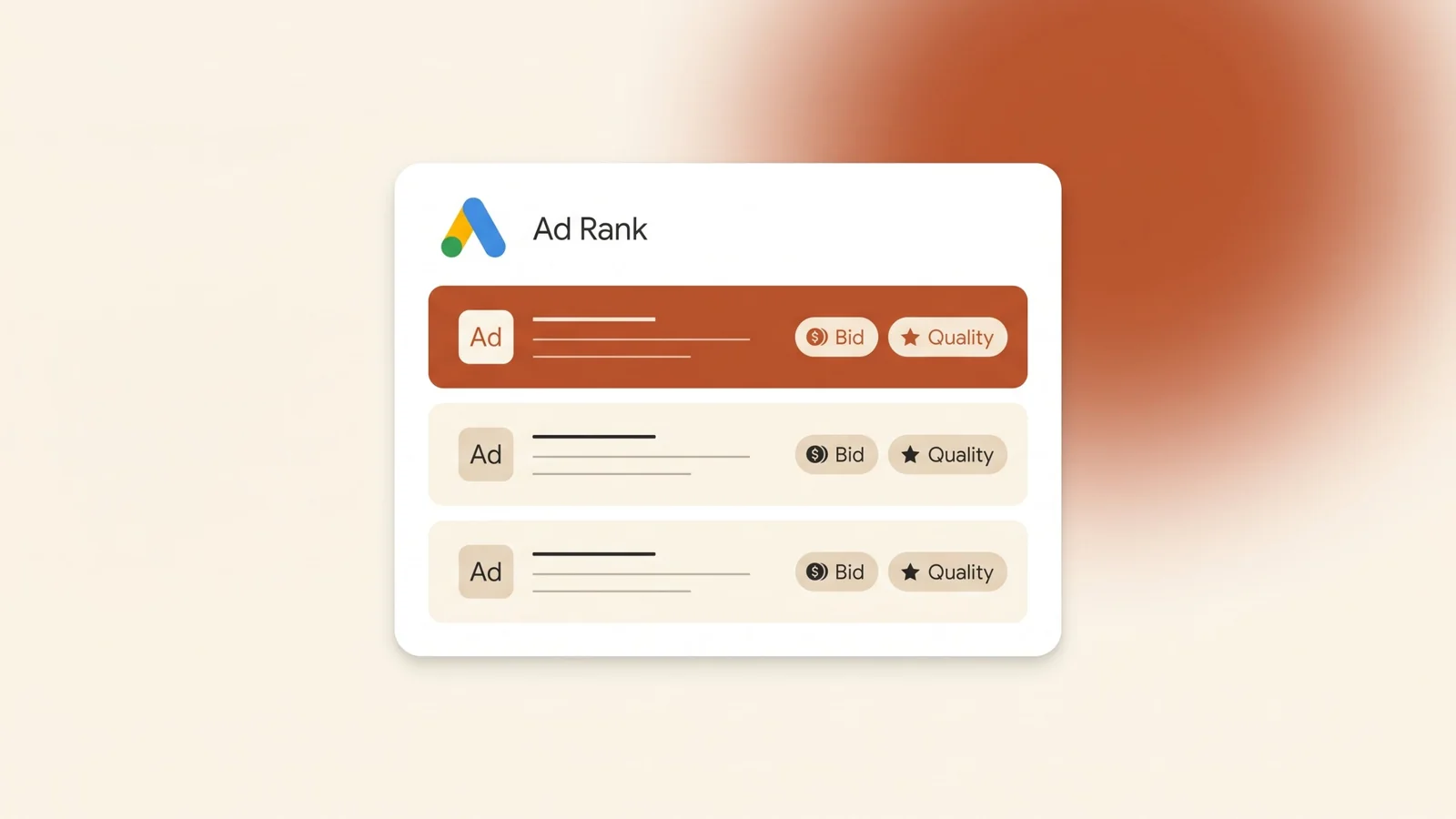
Ad Rank decides. Google’s page About Ad Rank lists six factors that go into it:
- Your bid. The most you are willing to pay for a click.
- The quality of your ads and landing page. How relevant and useful they are to the person searching.
- The Ad Rank thresholds. The minimum an ad must reach to show in a position.
- The competitiveness of the auction. How close the other advertisers are to you.
- The context of the search. Google looks at the search terms, the person’s location, their device, the time of the search and other signals.
- The expected impact of your ad assets. Extras such as sitelinks or a call button.
Google calculates Ad Rank every time a user searches. It also says that relevant keywords, ads and assets can help an advertiser win a higher position at a lower price, even against competitors with higher bids. So a bigger bid is not the only lever, and it is rarely the cheapest one. A clear ad that matches the search, sending people to a page about exactly that service, works in your favour in every auction.
What is Quality Score?
Quality Score is Google’s summary of how your ad quality compares with other advertisers. Google’s guide About Quality Score says it is measured on a scale from 1 to 10 at the keyword level. It also says Quality Score is a diagnostic tool, not a key performance indicator, and that it is not itself an input in the ad auction. Treat it as a warning light: it points to what is weak, and fixing those things improves the quality signals the auction does use.
Quality Score has three parts. Google rates each one as “Above average”, “Average” or “Below average”, compared with other advertisers whose ads showed for the same searches over the last 90 days.
| Part | What Google measures | What to fix if it is below average |
|---|---|---|
| Expected click-through rate | How likely your ad is to be clicked when it shows. | Name the exact service and city in the headline. Use the words people search with, in Arabic and English. |
| Ad relevance | How closely your ad matches the intent behind the search. | Split keywords into small groups by service, so each ad speaks to one kind of search. |
| Landing page experience | How relevant and useful your landing page is to people who click. | Send each ad to a page about that service, with the same wording as the ad, that loads fast on a phone. |
Component definitions from Google’s Quality Score guide. The fixes are the usual starting points, not a guarantee of a higher score.
The landing page part is where many Saudi campaigns lose. Sending every ad to the homepage makes the visitor search again for the service they wanted. Our guide on landing page vs website for Google Ads covers what the page should contain.
How much do you pay for a click?
Usually less than your bid. Google separates two numbers in its definition of actual cost-per-click. Your maximum CPC bid is the most you will typically be charged for a click. Your actual CPC is the final amount you are charged, and it is usually lower.
The reason is how the price is set. Google says you pay only what is needed to beat the Ad Rank of the advertiser directly below you and to clear the Ad Rank threshold. Because quality is part of Ad Rank, a better ad can hold the same position for a lower price. Google’s Ad Rank page puts it plainly: higher quality ads can often lead to lower CPCs.
There are exceptions. Google notes that ads above the search results typically cost more per click than ads below them, and that automated bidding strategies can charge more than a maximum CPC you set. What a click costs in your sector depends on competition, so our guide to Google Ads cost in Saudi Arabia walks through the factors that set it.
How do keywords decide when your ad shows?
Keywords are the words and phrases you choose so that your ad can enter the auctions for matching searches. The match type you give each keyword controls how close the search has to be. Google’s guide to keyword matching options defines three:
| Match type | How you write it | When your ad can show |
|---|---|---|
| Broad match | dental clinic Jeddah | On searches related to the keyword, including some that don’t contain its words. This is the default for every new keyword. |
| Phrase match | "dental clinic Jeddah" | On searches that include the meaning of the keyword, including more specific versions of it. |
| Exact match | [dental clinic Jeddah] | On searches with the same meaning or intent as the keyword. Most control, fewest searches. |
Definitions from Google’s keyword matching options guide.
Negative keywords do the opposite. Google says negative keywords let you exclude search terms from your campaigns. Words such as “jobs”, “course” or “free” are common negatives for a service business. To find the rest, open the search terms report, which lists the searches that actually triggered your ads.
In Saudi Arabia, plan keywords in both languages. People search for the same service in Arabic and in English, and Arabic terms often have more than one spelling. Our keyword research guide for beginners shows how to build the list.
How does your daily budget get spent?
You set an average daily budget for each campaign, and Google spends it over the month, not evenly each day. Google’s page on average daily budgets says a single day can spend up to two times your average daily budget for most campaigns. It also says your monthly spend is capped at 30.4 times your average daily budget, and you won’t be charged more than those limits.
In practice, don’t judge a campaign by one expensive day. Judge it by the month. If one day spends more than your daily budget, another day usually spends less. If you only want ads to run when someone can answer the phone, set an ad schedule for your working hours, and adjust it for Ramadan and Eid.
Which campaign type should you start with?
Google Ads has several campaign types, and each shows ads in different places. Google’s guide to choosing the right campaign type describes them like this:
| Campaign type | Where ads show | Usually fits |
|---|---|---|
| Search | Text ads on Google search results. | Service businesses that want calls and enquiries from people searching now. |
| Performance Max | All Google Ads inventory from one campaign. | Advertisers with reliable conversion tracking and enough data for Google’s automation. |
| Display | Visual ads on websites, to a relevant audience. | Reminding past visitors or building awareness. |
| Video | Video ads on YouTube and other websites. | Brands with video content. |
| Shopping | Product listings on Google. | Online stores with a product catalogue. |
| App | Ads that find new app users. | Businesses with a mobile app. |
“Where ads show” follows Google’s campaign type guide. “Usually fits” is general guidance.
For a law firm, a clinic, a contractor or any other local service, a Search campaign is the clearest place to start. You choose the searches, you see the search terms, and you can tie each click to a call or a form.
What happens after the click?
The auction ends at the click. Whether you get a customer depends on what happens next. Three things matter:
- The page. The visitor should land on a page about the service they searched for, with a call button, a WhatsApp button and a short form near the top.
- The reply. A call that rings out or a WhatsApp message answered the next day is a click you paid for and lost.
- The tracking. Without conversion tracking, you can’t tell which keyword brought which call, and you can’t tell what to keep and what to cut. Our Google Ads conversion tracking guide shows how to set it up for calls, forms and WhatsApp.
How does it all fit together?
Picture a dental clinic in Jeddah that runs a Search campaign. Someone in Jeddah types “تبييض الأسنان جدة” at nine in the evening. The clinic’s phrase-match keyword matches, so its ad enters the auction alongside other clinics. Google calculates Ad Rank for each one, using their bids, the quality of their ads and pages, and the fact that the searcher is on a phone in Jeddah.
The clinic’s ad names teeth whitening in its headline and links to a teeth whitening page, not the homepage. That relevance helps its Ad Rank, so it can show near the top without having the highest bid. The person clicks, and the clinic pays the actual CPC, which is no more than it needed to beat the ad below it. The page loads fast, the person taps WhatsApp, and conversion tracking records which keyword brought that message. Next week, the clinic knows which searches to spend more on.
Frequently asked questions
Does the highest bidder always get the top spot on Google Ads?
No. Position is set by Ad Rank, which combines your bid with the quality of your ad and landing page, the Ad Rank thresholds, the competitiveness of the auction, the context of the search and the expected impact of your assets. Google says relevant keywords, ads and assets can win a higher position at a lower price, even against higher bids.
Do I pay every time my ad is shown?
Not on Search campaigns that bid per click. You pay when someone clicks the ad, and the actual cost per click is usually lower than your maximum bid, because you pay only what is needed to beat the Ad Rank of the ad below yours.
What is a good Quality Score?
Google measures Quality Score from 1 to 10 and calls it a diagnostic tool, not a performance target. Look at its three parts instead of the number. Fix any part marked “Below average” first: expected click-through rate, ad relevance or landing page experience.
Can Google spend more than my daily budget?
Yes, on a single day. For most campaigns, Google can spend up to twice your average daily budget in one day. Over the month, your spend is capped at 30.4 times your average daily budget.
Which keyword match type should I start with?
Phrase and exact match give you the most control over which searches trigger your ads. Broad match is Google’s default and reaches the most searches, including related ones. If you use broad match, check the search terms report often and add negative keywords.
The bottom line
Google Ads is an auction that runs on every search. Your keywords get you into it, Ad Rank decides where you show, and you pay per click only what it takes to beat the ad below you. A higher bid helps, but a relevant ad, a focused landing page and proper tracking help in every single auction, and they lower what each lead costs you.
Kyvo Media builds and manages Search campaigns in Arabic and English through our Google Ads management service, from keywords and ads to landing pages and conversion tracking. Book a free audit and we’ll show you where your current campaign is losing auctions or paying more than it needs to.